

Trump signals new Iran talks as Bitcoin surges past $64K

Bitcoin has climbed above the $64,000 level after U.S. President Donald Trump confirmed that the United States has agreed to continue talks with Iran following a new request from Tehran.
Summary
- Trump confirmed the U.S. will continue talks with Iran after a new request from Tehran.
- Bitcoin climbed above $64,000 as markets reacted positively to the diplomatic update.
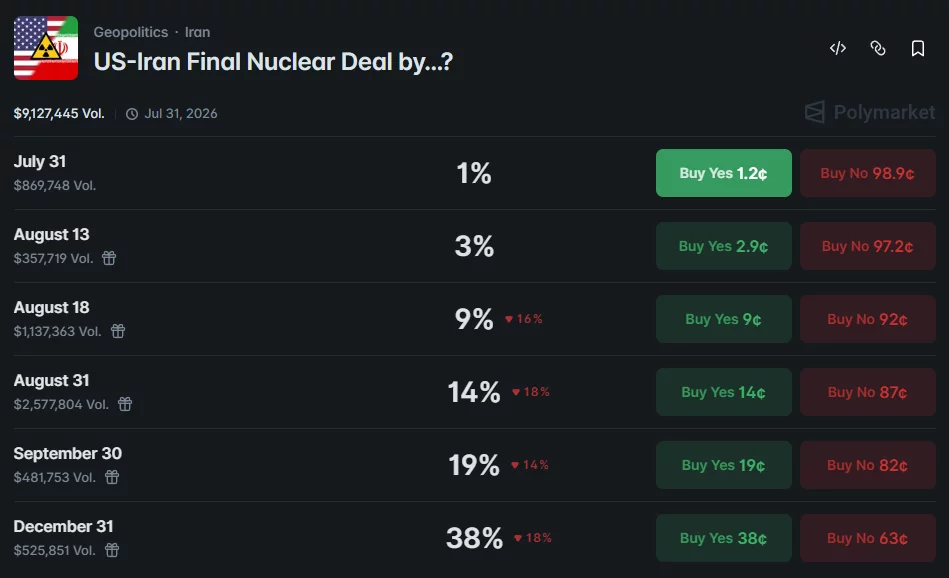
- Polymarket still places the odds of a U.S.-Iran nuclear deal by year-end at just 38%.
According to a post by President Trump on Truth Social, Iran asked to resume discussions with the United States, and Washington agreed to continue negotiations. At the same time, Trump stated that the ceasefire was over, indicating that diplomatic engagement would continue despite the end of the truce.
“The Islamic Republic of Iran has asked us to continue “talks.” We have agreed to do so, but the United States has stated to them, in no uncertain terms, that the Cease Fire is OVER!”
The cryptocurrency market reacted positively to the development. Bitcoin (BTC) rose to around $64,100, gaining nearly 2% from an intraday low near $62,000. The move extended the recovery that began after heavy selling earlier this week, when renewed military exchanges between the U.S. and Iran pushed Bitcoin below the $62,000 mark.
crypto.news had previously reported that technical discussions between U.S. and Iranian officials were expected to continue. Trump’s latest statement publicly confirmed that negotiations remain active even as military tensions have yet to fully ease. Alongside Bitcoin, several major cryptocurrencies also traded higher following the announcement.
Bitcoin recovers as diplomatic contacts continue
Market sentiment improved after Trump’s latest comments suggested that both sides remain engaged in negotiations despite recent hostilities. Earlier, the president had also stated that Iran wanted to make a deal “so badly,” adding to expectations that diplomatic channels had not completely broken down.
Even with Bitcoin reclaiming the psychological $64,000 level, traders continue to monitor geopolitical developments closely because recent market swings have been closely tied to headlines surrounding the conflict. This week’s decline below $62,000 came shortly after both countries exchanged strikes and Trump declared that the ceasefire had ended.
The recovery also follows several sessions of elevated volatility across digital assets, with investors reacting quickly to changes in geopolitical risk. Although Bitcoin has regained lost ground, price movements remain sensitive to further developments from Washington and Tehran.
Nuclear agreement expectations remain limited
Despite the renewed talks, prediction markets continue to show limited confidence that the two countries will finalize a nuclear agreement this year. According to Polymarket data, the probability of the United States and Iran reaching a deal by Dec. 31 stands at about 38%.
The nuclear program remains the central issue separating both sides. President Trump has repeatedly maintained that Iran cannot possess a nuclear weapon, while negotiations continue alongside ongoing military and political tensions.
Energy markets remain another source of uncertainty for investors. Iran has maintained that it plans to impose tolls on vessels passing through the Strait of Hormuz, a route that carries a significant share of global oil shipments. The possibility of higher transportation costs has kept traders focused on potential disruptions to crude supplies.
Earlier this week, oil prices climbed after Iran attacked three oil tankers in the Strait of Hormuz, escalating the conflict and adding fresh inflation concerns. Higher energy prices can increase inflationary pressure, a factor that financial markets often watch because persistent inflation may reduce expectations for easier monetary policy, which can weigh on risk assets such as Bitcoin.
For now, Bitcoin’s move above $64,000 suggests investors welcomed signs that diplomatic contacts remain open. Even so, the market continues to balance improving sentiment from renewed negotiations against the unresolved issues surrounding Iran’s nuclear program and the ongoing risks to global energy supplies.